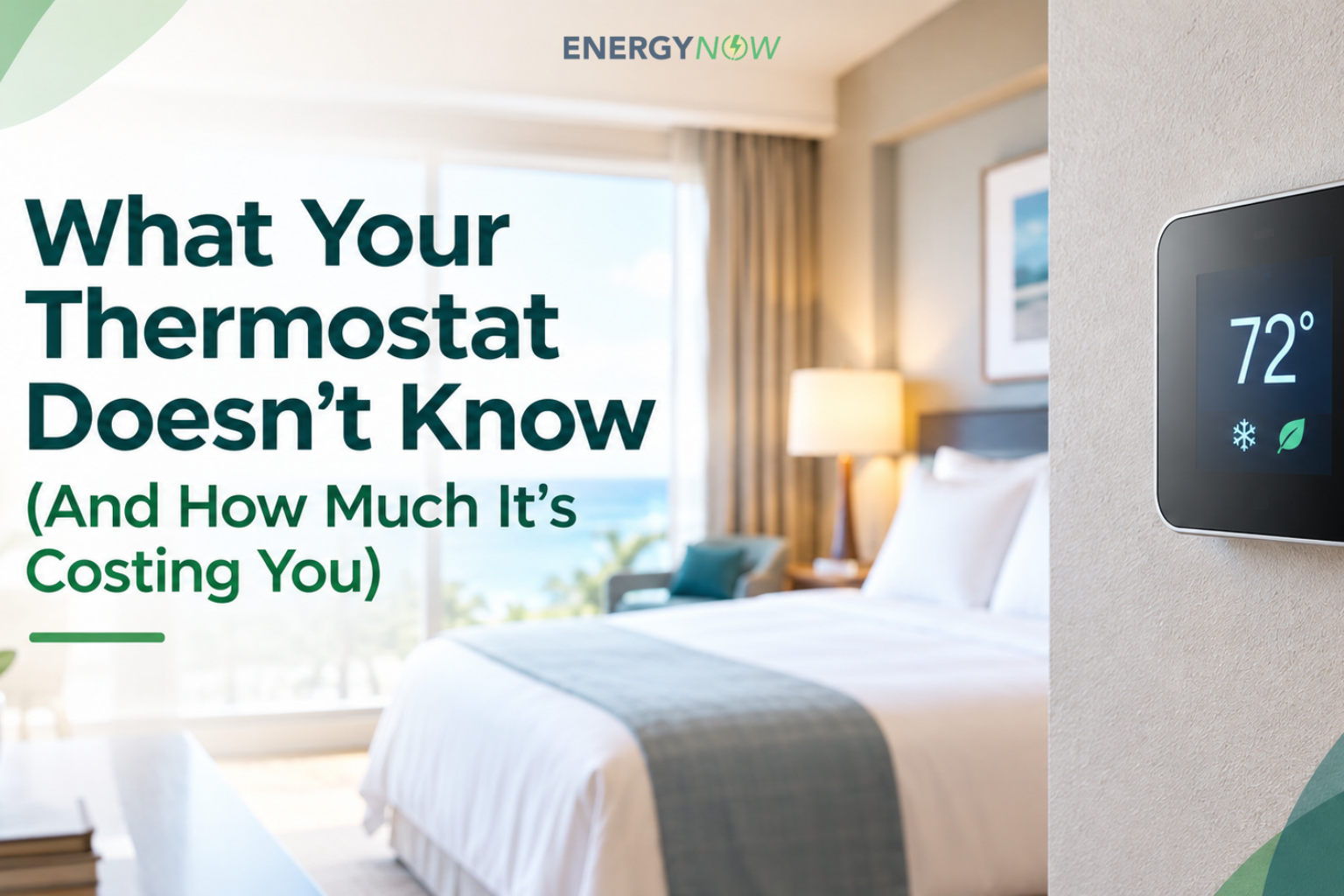
Your hotel’s thermostat is doing its job. The problem is that its job description was written decades ago — and it has no idea your guests left three hours ago.
The Dumb Thermostat Problem
A traditional thermostat compares the room temperature with its set point and runs the HVAC until they match. It has no awareness of occupancy or guest schedules. A room may sit empty for hours after checkout, yet the system continues to operate toward the same target. It also can’t weigh whether running the system now or waiting two hours would cost less. It responds to temperature alone.
What an Occupancy-Based System Knows Instead
Smart thermostats and occupancy-based HVAC controls combine sensors, door status, key card data, and sometimes reservation system integration in order, to build a real-time picture of room status. For example, when a room is vacant, the system automatically relaxes the temperature set-point — to 78°F in summer, 65°F in winter — and returns to comfort range 20–30 minutes before the next expected arrival. The guest walks into a comfortable room. The hotel paid to condition it for a fraction of the time.
| ⚡ Energy Now Tip: The ROI on occupancy-based thermostats in hotels is among the fastest in the industry — typically 12–24 months. A 200-room property can see $35,000–$60,000 in annual HVAC savings with no change to the guest experience. |
Beyond On/Off: What Else Your System Can Learn
Modern smart building platforms go further than simple occupancy detection. They learn your property’s thermal characteristics — how fast each room heats or cools based on orientation, floor level, and room type — and optimize per-conditioning timing for each room individually. A south-facing corner suite in August needs different treatment than a north-facing interior room. A system that learns this pays for itself faster than one that applies a uniform rule.
The Retrofit Question: Do I Need to Gut My System?
For most hotels, the answer is no. The majority of smart thermostat platforms are designed to retrofit onto existing fan coil units and HVAC infrastructure using wireless communication. No new duct-work, no new electrical runs, no guest room closures during installation. A typical 150-room retrofit takes 5–7 days of work spread across available rooms.
| ⚡ Energy Now Tip: Ask vendors for a reference site in a hotel with similar infrastructure before committing. Retrofit compatibility varies by HVAC type — PTACs, fan coils, and VRF systems each have different integration paths. |
Connecting to Your PMS
The highest-performing installations integrate the smart thermostat system with your property management system, so departure status triggers immediate HVAC setback and confirmed arrivals trigger per-conditioning at exactly the right time. Most major PMS platforms (Opera, Maestro, Cloudbeds, and others) support this integration through APIs or middle-ware. The result is a system that’s always one step ahead of your guests.
Technology that your guests never notice is the best kind — because it just works. Energy Now evaluates, selects, and manages smart HVAC deployments for hotel clients, from the first vendor conversation through the final energy verification report.
Ready to start saving? Energy Now makes it simple.
Contact us today for a free energy audit → info@energynow.online