You track room occupancy obsessively. You know your RevPAR, your ADR, your GOPPAR. But there’s one occupancy rate almost no hotel measures — and it might be your single largest source of avoidable energy cost.
Energy Occupancy Rate: A Metric Worth Knowing
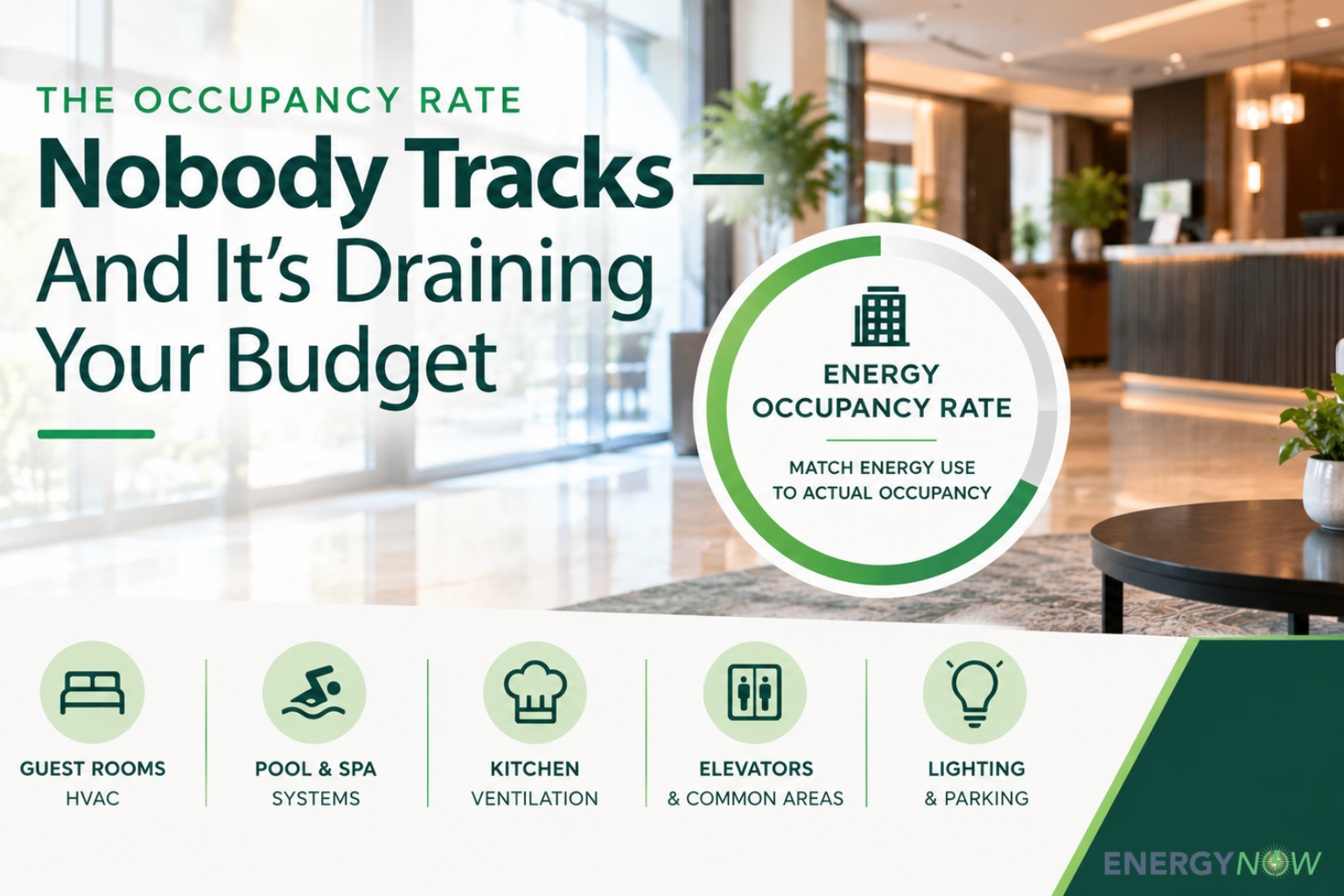
Energy occupancy rate is simple: what percentage of your energy-consuming systems are in use relative to the people actually in the building? A hotel running at 60% room occupancy but conditioning 95% of its guest rooms, lighting 100% of its corridors, heating its full pool, and running all kitchen stations is operating with a very poor energy occupancy rate — paying for capacity that’s serving nobody.
The Systems Most Likely to Be Over-Running
Guest room HVAC is the biggest offender, followed by pool and spa systems running at full capacity regardless of usage, kitchen ventilation hoods that run at full speed even during off-peak hours, elevator banks with all cars active overnight, and parking structure lighting at full brightness at 3 AM. Taken together, these loads can represent 25–35% of a hotel’s total energy spend — running for guests who aren’t there.
| ⚡ Energy Now Tip: Pull your overnight electricity data from your utility’s interval metering. Compare it to your overnight occupancy percentage. If the gap between those two numbers is more than 15 points, you have significant optimization opportunity in your baseline. |
Zone-Based Management: Matching Energy to People
The solution is zone-based energy management — dividing the hotel into logical zones (floors, wings, function areas) and scaling energy use in each zone to match actual occupancy. If your hotel fills from the bottom up, floors 7–12 should be in setback mode until they’re needed. If the banquet hall is empty on a Tuesday, its HVAC, lighting, and AV infrastructure should be too.
| ⚡ Energy Now Tip: Work with your front desk and housekeeping teams to cluster room assignments on fewer floors during low-occupancy periods. This simple operational change reduces the number of conditioned zones and can cut HVAC energy by 10–15% on nights below 50% occupancy — with no technology investment required. |
Kitchen Ventilation: The Hidden Drain
Commercial kitchen hoods are among the most energy-intensive systems in a full-service hotel — and they frequently run at full speed during prep-only or post-service periods when cooking intensity is minimal. Demand-controlled kitchen ventilation (DKVE) systems use sensors to measure cooking activity and modulate hood fan speed accordingly, cutting kitchen ventilation energy use by 30–50% without compromising air quality.
Measuring Your Own Number
Start tracking energy use per occupied room night — total energy (kWh + BTUs) divided by rooms sold. Benchmark it monthly. As you implement occupancy-aligned strategies, this number should fall. A well-managed mid-service hotel typically achieves 20–35 kWh per occupied room night; if you’re significantly above that range, there’s room to move.
Energy occupancy is a new way to think about an old problem. The hotels that master it don’t just lower their bills — they build more resilient operations that scale their costs to match their revenue. Energy Now helps clients establish this metric and build the operational and technical playbook to improve it.
Ready to start saving? Energy Now makes it simple.
Contact us today for a free energy audit → info@energynow.online