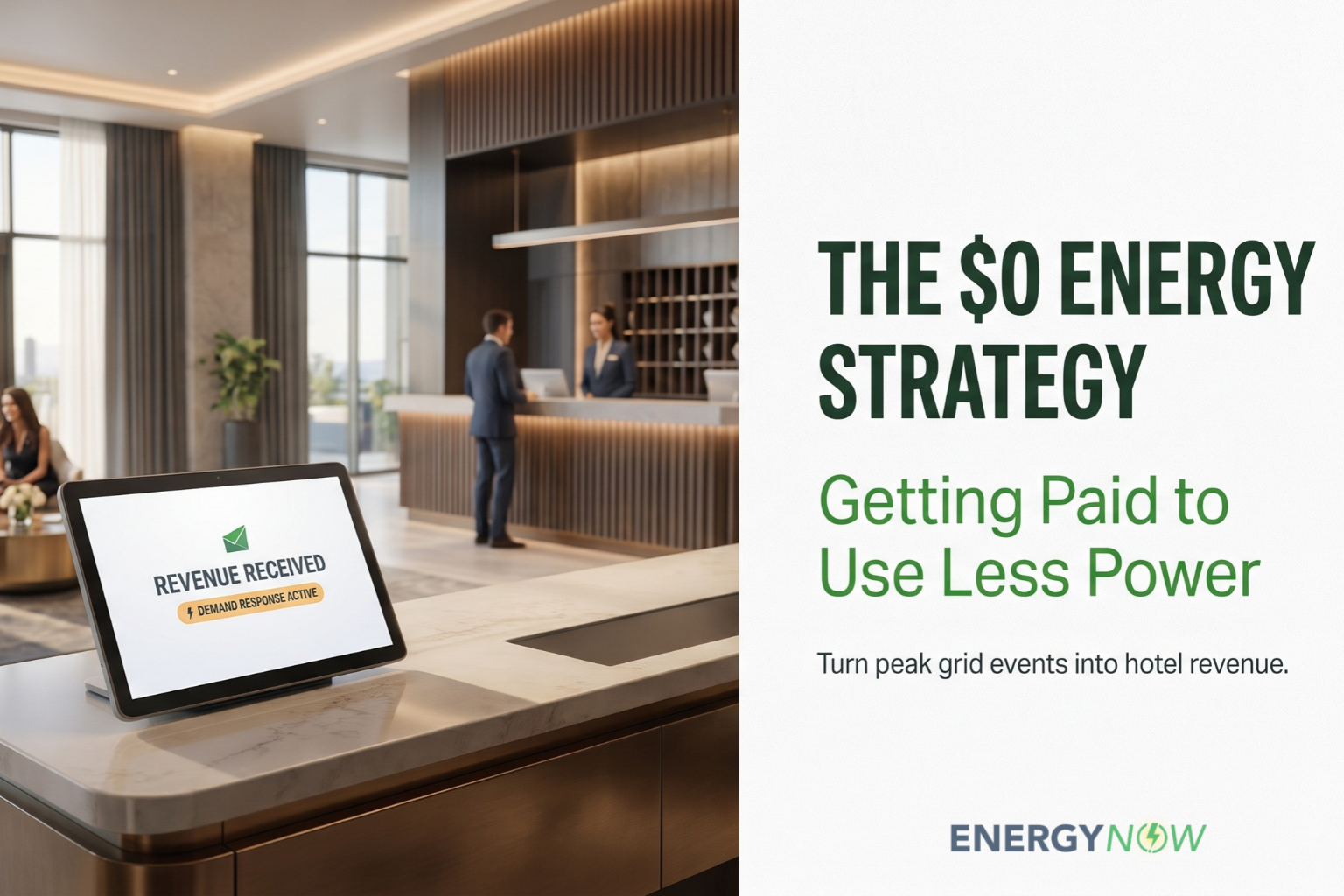
What if your utility paid you — not the other way around? For many hotel operators, that’s not a hypothetical. It’s an underused program sitting quietly in the fine print of their utility agreement.
What Is Demand Response?
Demand response (DR) is a utility program that pays commercial customers to voluntarily reduce their electricity consumption during periods of peak grid stress — usually hot summer afternoons or extreme cold events when grid operators need to balance supply and demand quickly. When the call comes, you reduce load for a defined period. In exchange, you receive incentive payments — sometimes substantial ones.
What Grid Stress Events Look Like for a Hotel
A demand response event typically lasts 2–4 hours, occurs 5–15 times per year, and is called with 30 minutes to 24 hours of advance notice depending on the program. During the event, your hotel reduces load — typically 10–20% — by slightly relaxing HVAC setpoints, dimming common area lighting, and temporarily reducing pool heating. Guests rarely notice. The utility writes you a check.
| ⚡ Energy Now Tip: The best demand response programs pay in two ways: a capacity payment for simply being enrolled and available (paid monthly regardless of events), and a performance payment for each event where you successfully reduce load. Together, these can total $10,000–$25,000 per year for a 200-room hotel. |
$18,000
average annual demand response earnings for an enrolled 200-room full-service hotel in a PJM-region utility territory.
Automation Makes It Invisible
The barrier most hotels cite for not enrolling is operational complexity — how do you respond to an event signal quickly without disrupting guests or pulling staff from other duties? The answer is automation. Building automation systems and smart building platforms can receive the utility event signal and automatically implement the pre-programmed load reduction protocol. No staff action required. The load drops, the event passes, the system recovers. The check arrives.
| ⚡ Energy Now Tip: Before automating demand response, define your load reduction playbook: exactly which systems you’ll curtail, by how much, and in what sequence. Test it during a low-occupancy period. Once it’s set, it runs itself. |
How to Find Your Program
Demand response programs vary by utility and regional grid operator. In PJM territory (Mid-Atlantic and Midwest), programs are robust and payments are among the highest in the country. In ERCOT (Texas), demand response is increasingly available through retail electricity suppliers. ISO-NE and NYISO also offer commercial DR programs. Your utility account representative or a broker like Energy Now can identify every program available in your service territory.
The Virtual Power Plant Opportunity
A newer development is the aggregation of hotel demand response capacity into virtual power plants — where a platform enrolls multiple commercial customers together to meet minimum program thresholds and distribute payments. This opens DR participation to smaller properties that wouldn’t qualify on their own. For a 60-room boutique hotel, aggregated DR enrollment may be the path to participation.
Demand response is real money for doing something your building can do automatically. Energy Now identifies, enrolls, and manages DR participation for hotel clients — handling everything from program selection to performance verification so you collect the payment without the work.
Discover how strategic energy management can support your bottom line — connect with us today for a consultation.