Energy management gets dramatically easier when you understand exactly when your hotel uses electricity and gas — not just how much over a month. A 24-hour energy map reveals the peaks your utility charges extra for, the valleys where you can shift loads, and the baseline loads that run around the clock without anyone noticing. Here’s what a typical full-service hotel’s day looks like through an energy lens.
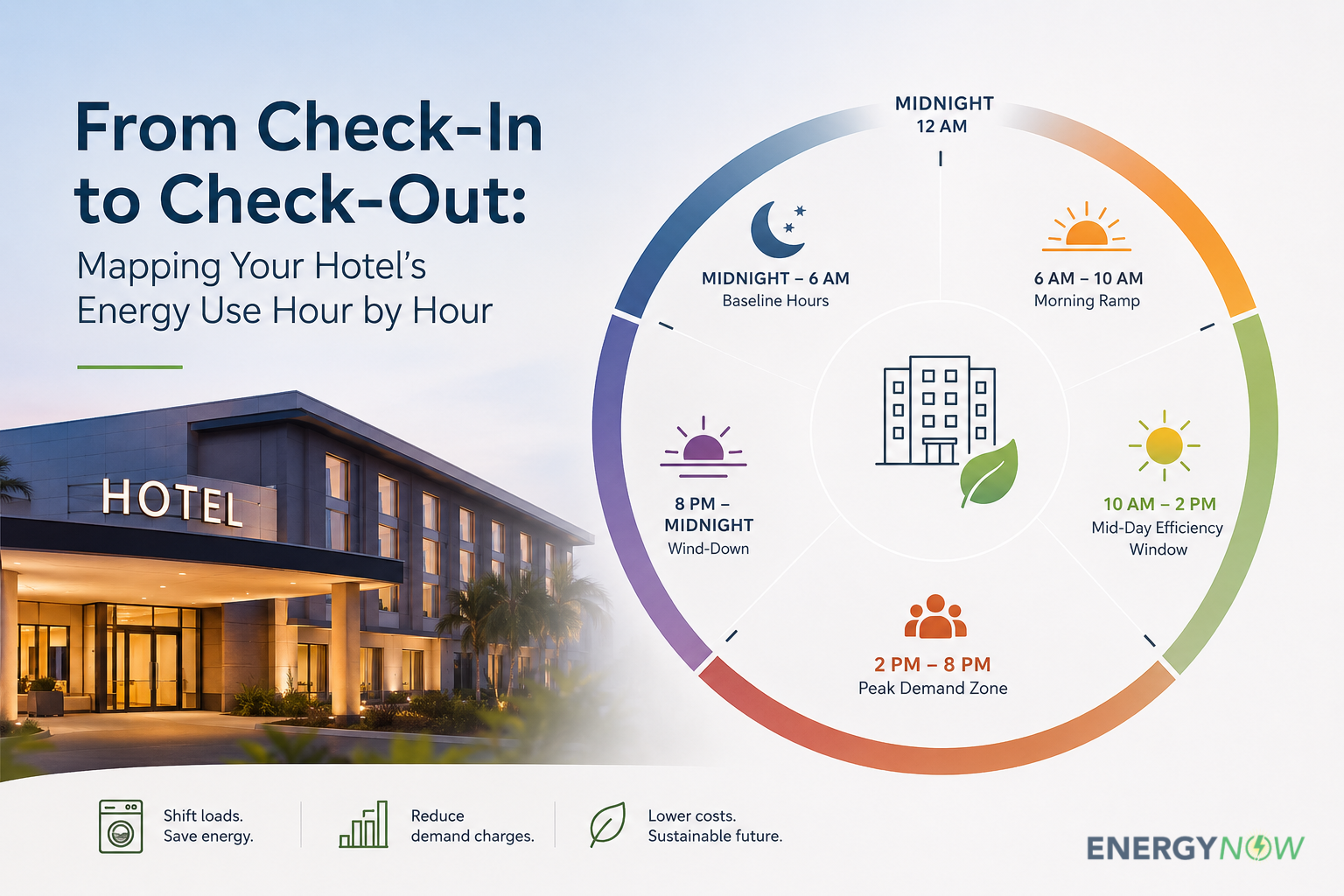
Midnight to 6 AM: The Baseline Hours
Overnight energy use is dominated by the base load — the systems that run regardless of occupancy: refrigeration in food and beverage areas, security and IT systems, elevators on standby, exterior lighting, pool and spa filtration, and HVAC maintaining setback temperatures in occupied rooms. This is also when many hotels run dishwashers and laundry from the prior evening’s service. Overnight is typically the cheapest electricity of the day in time-of-use rate structures, making it the ideal window for any shiftable loads.
| ⚡ Energy Now Tip: If your hotel has on-site laundry, scheduling wash cycles to start at midnight takes advantage of the cheapest electricity of the day. For properties on time-of-use rates, this shift alone can cut laundry energy costs by 20–35%. |
6 AM to 10 AM: The Morning Ramp
Breakfast service begins, bringing the kitchen to full operation — convection ovens, steamers, commercial dishwashers, and beverage equipment all come online. Guest rooms begin demanding hot water as occupants shower. Demand for heating or cooling rises as outdoor temperatures shift. This two-hour window from roughly 7 to 9 AM is often when a hotel first hits its morning demand peak — a number your utility measures and charges for.
10 AM to 2 PM: Mid-Day Efficiency Window
For many hotels, mid-morning to early afternoon is a relative lull — breakfast service is complete, checkout is underway, and the next occupancy wave hasn’t arrived. This is an opportune window for high-energy tasks: running the industrial laundry, performing kitchen deep cleans, scheduling HVAC maintenance. In solar-heavy markets like California, mid-day is also when grid electricity is cheapest and cleanest.
| ⚡ Energy Now Tip: Hotels with on-site solar panels often see peak generation between 10 AM and 2 PM. Scheduling high-draw tasks during this window maximizes self-consumption and reduces grid purchases. |
2 PM to 8 PM: The Peak Demand Zone
Late afternoon through evening is typically a hotel’s most energy-intensive window. HVAC loads peak as outdoor temperatures max out. Kitchen ramps up for dinner service. The pool fills with guests. Meeting rooms and event spaces are at capacity. Valet, spa, and fitness center traffic peaks. In most utility rate structures, this window carries the highest per-kWh rate and the highest demand charge exposure. Every kilowatt you can shift out of this window is disproportionately valuable.
| ⚡ Energy Now Tip: Smart thermostats can pre-cool guest rooms to comfortable temperatures by 1 PM, allowing HVAC setback during the 3–7 PM peak window — when guests are often not in their rooms anyway. This is one of the highest-ROI demand management strategies for hotels. |
8 PM to Midnight: The Wind-Down
As evening service concludes, energy demand begins to moderate. Kitchens shut down equipment, event spaces clear, and HVAC loads ease as outdoor temperatures fall. This is a natural window for evening utility meter reading and for scheduling automated BAS setbacks. Hotels with good energy data will see their demand curve fall back toward the overnight baseline by 10–11 PM.
Building Your Hotel’s Energy Map
Your utility provides interval data — typically in 15-minute increments — that lets you see exactly this picture for your property. Overlaying occupancy data, rate structures, and weather adds additional insight. Energy management systems and smart meters make this analysis automatic and ongoing.
Most hotel operators manage energy with a monthly bill. The best ones manage it with a 24-hour lens. Energy Now can pull and analyze your interval data, overlay your rate structure, and identify the specific hours where your properties have the most opportunity to reduce costs.
Ready to take control of your hotel’s energy costs? Contact us today for a free consultation.