And how to lower that cost
Most hotel operators assume their energy bill is what it is. The rate is on the contract. The contract got signed. Done. Have you considered the hidden costs hiding in your contract?
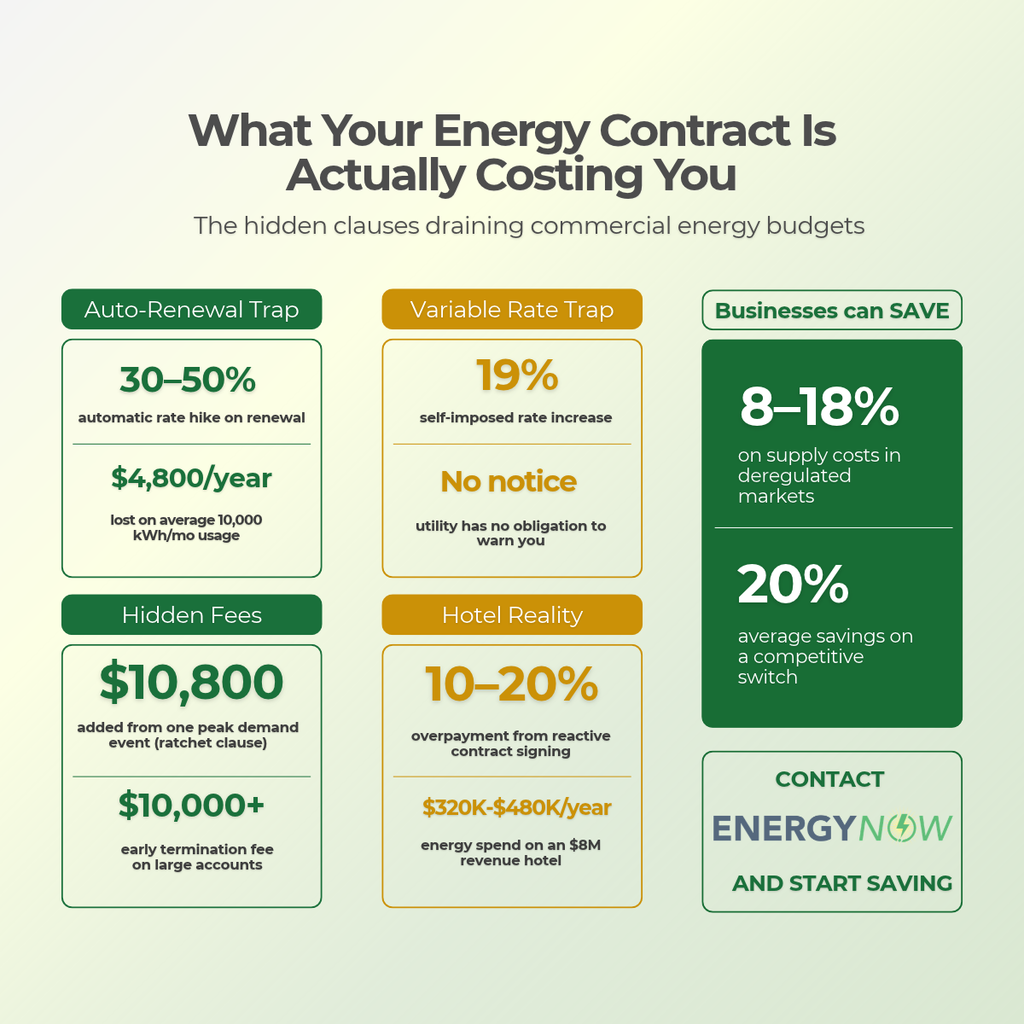
But the rate you agreed to and the rate you are actually paying are rarely the same number. And for hotels, where energy runs 4 to 6 percent of total revenue, the gap between those two figures is not a rounding error. On a property doing $8 million a year, that is $320,000 to $480,000 in electricity and gas before a single hidden charge touches it.
This is where the real cost lives: in the contract terms most operators never read before signing.
Here are four things in your energy contract that could be costing you more than you realize.
1. The Auto-Renewal Trap
The most expensive single clause in a commercial energy contract is not a rate. It is an auto-renewal provision.
Here is how it works: your fixed-rate contract expires. If you have not submitted a cancellation notice within a specific window, typically 30 to 90 days before the end date, the contract automatically renews. The problem is not the renewal itself. It is what you renew into.
Fixed-rate contracts that auto-renew convert to variable-rate plans priced 30 to 50 percent above your previous locked rate. A property paying 8 cents per kWh that auto-renews to 12 cents per kWh sees an immediate $400 increase per month on 10,000 kWh of usage. That is $4,800 per year from missing one deadline.
Some contracts include what are called “evergreen” renewal clauses, which reset the notification window on renewal, making it even easier to get locked in again. If a contract expires entirely and no active agreement is in place, the rates get worse: holdover or “deemed” rates run 40 to 80 percent above a properly negotiated deal.
The window to act closes before most operators realize it is open.
2. The Variable Rate Trap
Variable rate plans are sold as flexibility. In practice, they are one of the most common ways commercial energy costs spike without warning.
The pitch usually looks like this: a low introductory rate for the first few billing cycles, then a conversion to a market-based variable rate. The rate-change happens automatically, without explicit notice, because the contract already authorized it.
Here is a real example of what that looks like in numbers: a business that signed a 12-month fixed contract at $0.099 per kWh, missed the cancellation window, and auto-renewed to a variable tariff at $0.118 per kWh effectively imposed a 19 percent energy price increase on itself. No change in usage. No change in provider. Just a clause no one caught.
Variable rate exposure compounds during high-demand periods. When wholesale prices spike, variable rate customers absorb the full increase. For hotels, which run HVAC, laundry, kitchen equipment, and common area systems around the clock, this is not a theoretical risk.
3. Hidden Fees and Charges That Never Appear in the Rate
The rate on page one of your contract does not tell the full story. Here are the charges that do not show up there:
Demand ratchet clauses. These calculate your charges based on your highest short-term usage, not your average. A single peak event can set your demand charge baseline for the next 12 months. For a business paying $15 per kilowatt in demand charges, one high-usage event can cost an extra $10,800 over the following year.
Bandwidth penalties. Many commercial contracts require usage to stay within a specific range of historical consumption, often within 10 percent. If a renovation, low occupancy period, or operational change shifts your usage outside that band, penalties apply.
Capacity and pass-through charges. These are costs that suppliers can add on top of the supply rate based on grid conditions, regulatory changes, or market adjustments. Some contracts include language allowing suppliers to pass through these charges without a cap.
Contract initiation fees. A one-time charge of $200 to $1,000 with no clear value provided. Easy to miss because it shows up once and disappears from the bill.
Early termination fees. These vary widely by contract structure. The flat-fee version can exceed $10,000 for large commercial accounts. For high-usage properties, the fee can equal the total cost of all remaining unused energy on the contract.
Two providers quoting the exact same headline rate of 8 cents per kWh can cost a business $200 to $400 more per month once these terms are factored in. The energy rate is identical. The difference is in the contract language most operators never review before signing.
4. What This Adds Up To for Hotels
Hotels are one of the highest-energy-use categories in commercial real estate. A typical hotel in a deregulated state spends anywhere from $2,196 to $7,000 or more per room annually on energy, depending on property type, location, and operating hours.
The majority of operators in deregulated markets sign their energy contracts reactively. The current term ends, a renewal notice arrives, someone in accounting signs it to avoid an interruption. No competitive bidding process, no analysis of timing, no contract review. That pattern alone typically costs a property 10 to 20 percent more than a properly negotiated rate.
For operators that do shop competitively, the results are consistent. Commercial customers in active deregulated markets save an average of 8 to 18 percent on supply costs compared to default utility rates. Some save more: a pilot group of commercial accounts that switched providers cut their energy rate by an average of 20 percent.
What To do About It
The contract you have right now is worth reviewing and Energy Now can help you do it easily. Specifically:
- Pull the auto-renewal clause and confirm the notification deadline. If that date is approaching, you have a window to act.
- Look for how the rate is defined. Is it truly fixed, or does it include “index plus” language that creates variability within what looks like a fixed agreement?
- Check whether demand, capacity, or pass-through charges are bundled or itemized separately. Bundled rates obscure what you are actually paying for.
- If your contract is within 90 days of its end date, you are in the most valuable window you have for the next term.
Energy Now works with commercial operators in deregulated markets to review contracts, identify where costs are hidden, and secure supply rates through a competitive process. If you want a second set of eyes on your current agreement contact Energy Now to get a quote and secure a better rate.