Ask a hotel GM who their electricity provider is. Most will name their local utility — Con Edison, PSE&G, Duke, or whoever shows up on the bill. But in a deregulated market, the utility is only half the story. Understanding who does what on your bill is the first step to knowing where you actually have room to save.
The Utility’s Job: Delivery, Not Price
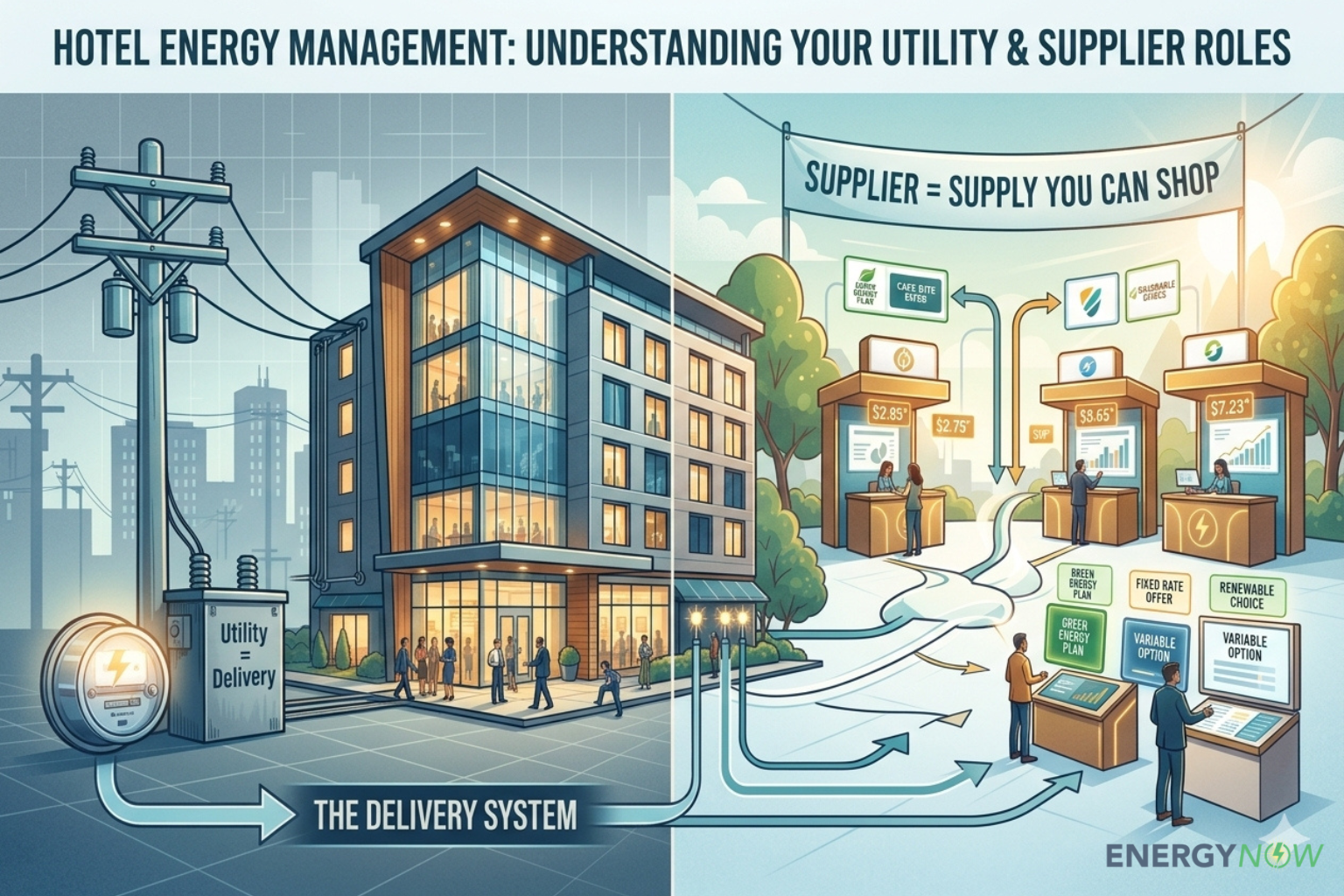
Regardless of which supplier you choose, your local utility continues to own the poles, wires, and meters. They deliver the electricity or gas to your property, respond to outages, and bill you for that delivery function. This portion of your bill is set by state regulators. The term delivery, distribution, or transmission describes this function. It doesn’t change, no matter who supplies your energy.
The Supplier’s Job: Generation, and the Part You Can Shop
The supply portion of your bill pays for the actual electricity or gas itself — the commodity. In a deregulated market, this is the part you’re free to shop across competing retail suppliers, each offering different rates and contract terms. If you’ve never actively chosen a supplier, you’re likely on your utility’s default supply rate, which is rarely the most competitive option available.
| ⚡ Energy Now Tip: Your bill will typically list both charges separately, sometimes under headings like ‘Delivery Services’ and ‘Supply Services’ or ‘Generation Charges.’ If you’ve never looked for this split, it’s worth pulling your last bill and finding it. |
Why the Confusion Persists
Designers craft bills around utility billing systems that predate deregulation, so the format rarely reveals the split. Many hotel operators simply see one total, pay it, and never realize a meaningful portion of that number was negotiable all along.
What This Means for Your Property
Your utility relationship doesn’t change when you switch suppliers — the wires, the meter, and the outage response stay exactly the same. What changes is who you’re buying the underlying electricity or gas from, and at what rate. That distinction is why switching suppliers involves no service interruption, no new equipment, and no operational disruption of any kind.
Once you understand which part of your bill is fixed and which part is competitive, the path to savings becomes a lot clearer. Energy Now helps hotel operators separate the two, benchmark the supply portion against the current market, and decide whether a change is worth making.
Curious which part of your bill you can actually shop? Click the link to schedule a call!